Salvage for Victory

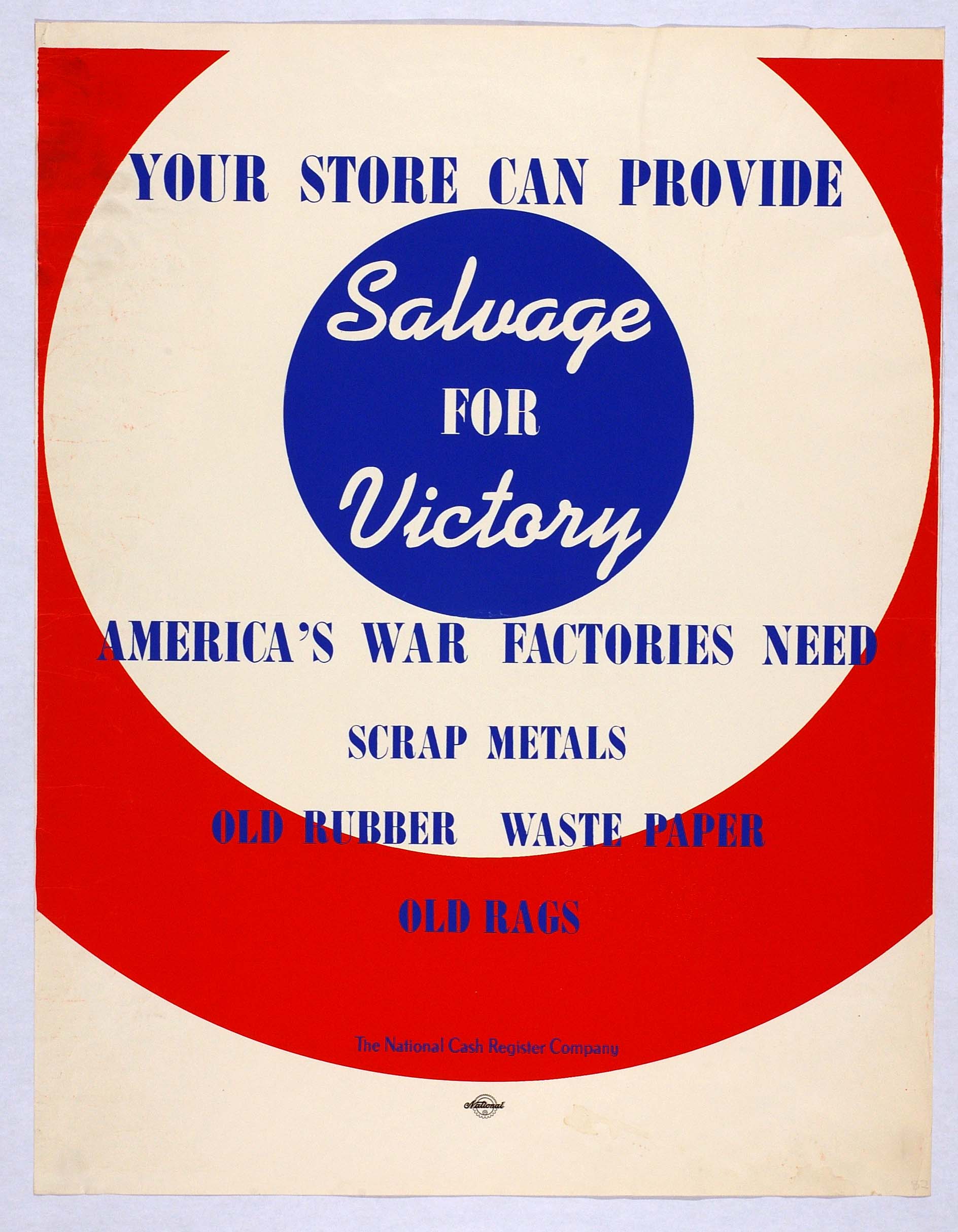
The Salvage for Victory campaign was a program launched by the US Federal Government in 1942 to salvage materials for the American war effort in World War II.
On January 10, one month after Pearl Harbor, 1942, the US Office of Production Management sent pledge cards to retail stores asking them to participate in the effort by saving things like waste paper, scrap metal, old rags, and rubber. Later that month, the Bureau of Industrial Conservation of the War Production Board asked all American mayors to salvage the same kinds of materials from municipal dumps and incinerators.
Recycling scrap metal and rubber allowed the government to use those materials to build ships, airplanes, and other needed equipment. This also allowed citizens to contribute to the war effort.
In New York City, the Department of Sanitation began picking up materials collected for the drive outside of homes and apartment buildings at 11:00 am Sunday mornings. The understanding of the process and cooperation of the American people is what will determine the success of this operation to move materials and support war efforts. Later on, these "drives" were later used to showcase the importance of non-economic motivations in politics such as patriotism and a sense of community in wartime. Materials such as metal, wood and rubber were needed for salvage and donated by families nationwide. Rubber, paper, metal, and rags were also collected through salvage drives.
Contributions
"Rationing" the materials was the primary way of conserving war time materials and products. The cooperation by many individuals in the US to the salvage program allowed for a greater available supply in war. Mickey Mouse and Bing Crosby played significant roles in promoting the Salvage for Victory. They emphasized the importance of the drives and the helpful impact it creates.
Women at home were also able to contribute to some of the programs established to salvage materials. Kitchen fats had just been recognized in 1942 to be useful in making soap. A byproduct during the manufacturing process of filtering/processing fats for soap was glycerine, widely known to make the explosive nitroglycerine. The American Fat Salvage industry actually paid consumers for the fats. Bacon grease, leftover pan juices, gravies, etc. all contributed to the fats being salvaged for their uses in war. 711e6lb of fats were collected in a matter of 4 years. The majority coming from civilian homes.
The end of the Salvage for Victory campaign did not end immediately after World War II ended. The need for materials continued as the United States transitioned to a peacetime economy. Government-mandates recycling and salvaging continued until the Office of Paper Control relaxed the Salvage Directorate on March 30, 1950. The Salvage for Victory campaign was not officially abolished, allowing the core concept of reusing and recycling for government use to continue to be relevant.
See also
References
- Jacqueline, Foertsch, American Culture in the 1940s, Edinburgh University Press, 2008
- 2022-01-11, Salvage For Victory: World War II & Now, 2025-05-07, The National WWII Museum , , New Orleans, en
- OPM Enlists Retailers in Waste Drive; Many Civilian Lead Uses Banned by Agency, The New York Times, 1942-01-10
- Asks Mayors to Aid Salvage for Victory, UP, The New York Times, 1942-01-31
- Fishman, Karen, 2015-01-15, Scrap for Victory! , , Now See Hear!, 2025-05-05, The Library of Congress
- Asks Scraps to Win War, The New York Times, 1942-01-30
- 77th United States Congress, govinfo.gov, 1942, Report on allocations and priorities of war materials. Letter from the Chairman of the War Production Board transmitting in response to Senate Resolution No. 195, a report of the Office of Production Management relating to the policy, methods, plans, and programs for the allocation or distribution of war materials. February 2, 1942. -- Referred to the Committee on Military Affairs and ordered to be printed with illustrations, S.Doc. 161, Washington, DC
- Rockoff, Hugh, Keep on Scrapping: The Salvage Drives of World War II, September 2007, Working Paper, 2025-03-24, Working Paper Series, National Bureau of Economic Research, 10.3386/w13418, 13418, free
- Civil Defense: Salvage for Victory, monheganmuseum.org, 6 October 2025
- Megan E., Springate, Material Drives on the World War II Homefront, 16 May 2024, National Park Service, 6 October 2025
- Riley, Mark, 2008, From salvage to recycling – new agendas or same old rubbish?, Area, en, 40, 1, 79–89, 10.1111/j.1475-4762.2008.00791.x, 2008Area...40...79R, 1475-4762, subscription
- 2022-01-11, Salvage For Victory: World War II & Now, 2025-05-05, The National WWII Museum, New Orleans, en
External links
- Salvage for Victory poster, another Archived 2016-03-03, at web.archive.org
- Loading household salvage in Salvage for Victory truck


Category:United States home front during World War II